
Source: Club Tourism
Kanazawa, the capital of Ishikawa Prefecture on Japan‘s Sea of Japan coast, is frequently described as Japan’s best-kept secret by those who have visited. Spared from bombing in World War II, the city retains an extraordinary concentration of preserved samurai and geisha districts, Edo-period architecture, and one of Japan’s three great gardens — all within a compact, walkable city that sees a fraction of Kyoto’s tourist volumes.
Kanazawa also has one of Japan’s richest seafood cultures, a thriving contemporary arts scene (home of the acclaimed 21st Century Museum), and a gold leaf industry that has produced 99% of Japan’s gold leaf for centuries. This guide covers everything a first-time visitor needs.
CONTENTS
- How to Get to Kanazawa from Tokyo or Osaka
- Top Sightseeing Spots in Kanazawa
- What to Eat in Kanazawa|Seafood & Gold Leaf
- Best Time to Visit Kanazawa
- Wi-Fi, eSIM & Staying Connected
- Summary|Planning Your Kanazawa Trip
How to Get to Kanazawa from Tokyo or Osaka
Source: Club Tourism
Kanazawa became significantly more accessible in March 2015 when the Hokuriku Shinkansen extended service directly to Kanazawa Station, reducing the journey from Tokyo from approximately 4 hours to around 2.5 hours.
From Tokyo
The Kagayaki (fastest, not JR Pass-compatible) from Tokyo Station reaches Kanazawa in approximately 2 hours 28 minutes. The Hakutaka (JR Pass-compatible) takes approximately 2 hours 56 minutes. One-way fare is approximately ¥14,120 (unreserved). This makes Kanazawa an excellent destination for a 2–3 night trip from Tokyo.
From Osaka/Kyoto
The traditional route via the Thunderbird limited express from Osaka Umeda/Kyoto runs to Kanazawa in approximately 2 hours 15 minutes from Osaka (¥7,130) and 2 hours from Kyoto. JR Pass holders can use this route. Note: a Hokuriku Shinkansen extension to Osaka is planned but not yet operational as of 2026.
Top Sightseeing Spots in Kanazawa
1. Kenroku-en Garden
Source: Japan Guide
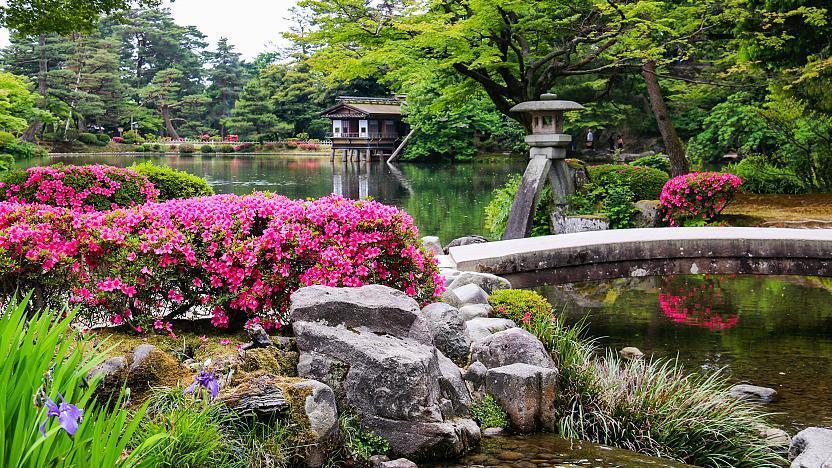
Kenroku-en is considered one of Japan’s Three Great Gardens and is Kanazawa’s single most visited attraction. The name means “garden of six characteristics” — a reference to the six qualities considered essential to a perfect garden in Chinese landscape theory: spaciousness, seclusion, artifice, antiquity, waterways, and panoramas. Developed by the Maeda clan over two centuries, the garden covers approximately 11.4 hectares and is exceptional in all four seasons. Admission is ¥320 for adults (free in early morning and winter). A 90-minute visit is recommended.
2. Higashi Chaya Geisha District
www.gltjp.com
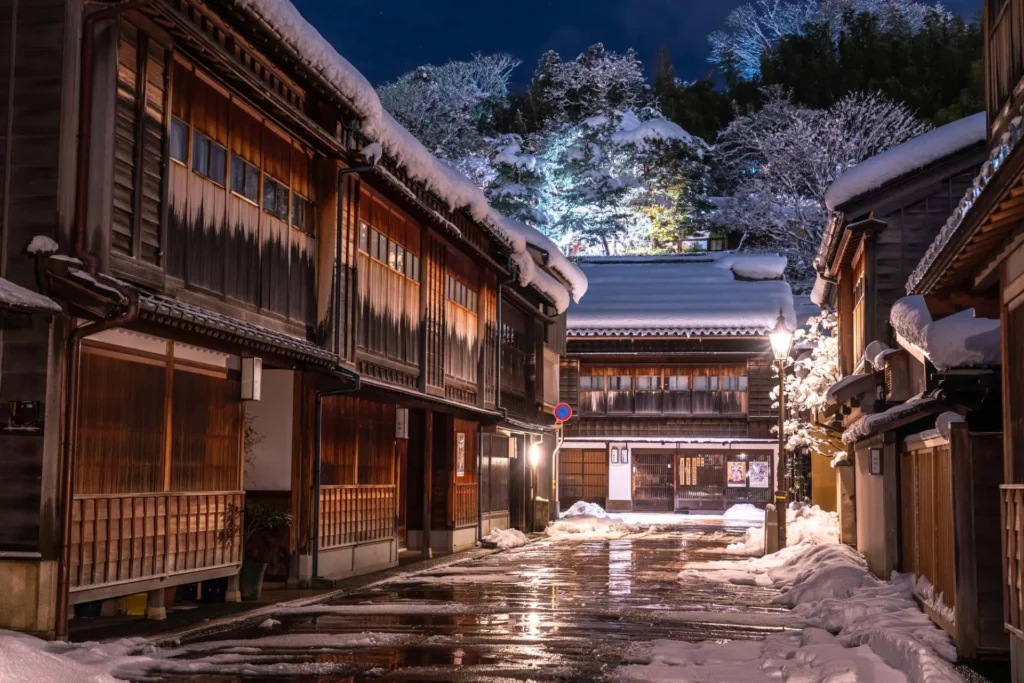
Higashi Chaya-gai is one of three preserved geisha entertainment districts in Kanazawa and one of the best-preserved in Japan outside of Kyoto. The district’s main street is lined with two-story wooden ochaya teahouses dating from the early 19th century, several of which are open to visitors. Shima and Kaikaro teahouses offer interior tours (¥750–¥750) providing a rare look inside the geisha entertainment world. The district is walkable from Kenroku-en in approximately 20 minutes.
3. Nagamachi Samurai District

Source: Trip To Japan
Nagamachi is a beautifully preserved samurai residential quarter in central Kanazawa, featuring earthen walls, narrow lanes, and traditional gateways typical of a feudal-era castle town. The Nomura Clan Samurai House (¥550) is open to visitors, offering an authentic interior view of a high-ranking samurai family’s home, complete with a garden noted for its sculpted pine trees. The district is most atmospheric in morning light before tour groups arrive.
4. 21st Century Museum of Contemporary Art
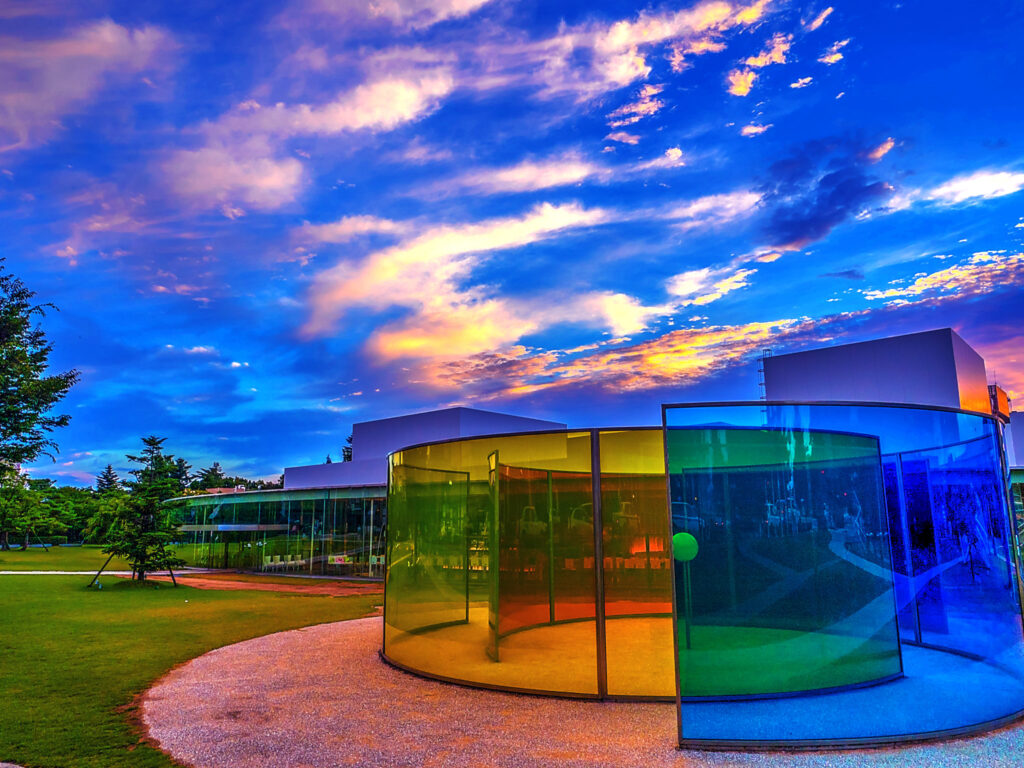
The 21st Century Museum of Contemporary Art, Kanazawa (SANAA-designed, 2004) is one of Japan’s most internationally acclaimed contemporary art institutions, famous for its circular design and permanent installations including Leandro Erlich’s “Swimming Pool” — an interactive work that creates the illusion of being underwater — and James Turrell’s immersive light installations. Admission to the exhibition zone is ¥1,200; the free civic zone surrounding the permanent collection is accessible without charge. Closed Mondays.
What to Eat in Kanazawa|Seafood & Gold Leaf
Source: Omicho Market Official Website
Kanazawa’s food culture is among Japan’s finest and most underrated. The city’s position on the Sea of Japan coast provides access to exceptional cold-water seafood, and its Edo-period prosperity as the wealthiest domain outside Edo produced a sophisticated culinary tradition.
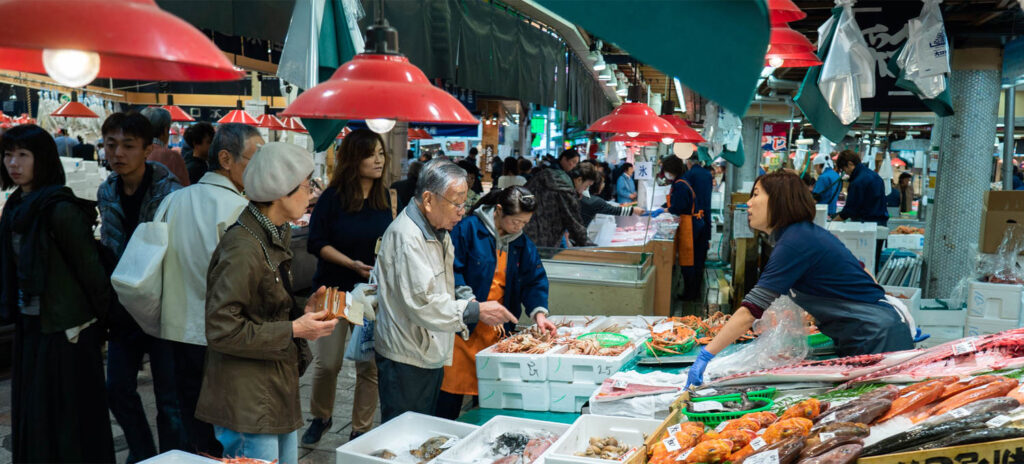
Kanazawa seafood is centered on Omicho Market — a covered market of approximately 170 stalls in the city center selling fresh fish, crab, and shellfish. The market is famous for Dungeness-like Zuwaigani crab (November–March), nodoguro (blackthroat seaperch), and amaebi (sweet shrimp). Many market stalls double as sushi restaurants serving the same fish they sell. Budget ¥2,000–¥4,000 for a kaisendon or sushi set at the market.
Gold leaf cuisine is a Kanazawa specialty born of the city’s centuries-old gold leaf industry. Gold leaf (99.99% pure, edible) is applied to ice cream, matcha sweets, sake, and desserts throughout the city’s cafes and confection shops. Gold leaf ice cream cones (¥700–¥900) near the Higashi Chaya district are among the city’s most photographed experiences.
Jibie ryori (wild game cooking using locally hunted deer and boar) is an emerging Kanazawa specialty at several izakayas, reflecting the abundance of the Noto Peninsula’s mountain hunting traditions.
Best Time to Visit Kanazawa
Source: HIS USA
Kanazawa’s Sea of Japan climate means more cloud cover and precipitation than Pacific-facing cities, but this also produces some of Japan’s most dramatic seasonal landscapes.
Spring (late March–April) brings cherry blossoms to Kenroku-en and the Kanazawa Castle Park, and the weather is generally mild. This is Kanazawa’s most crowded season — a significant increase in visitor numbers following the Shinkansen extension.
Autumn (October–November) offers vivid foliage throughout Kenroku-en and the Gyokuseninmaru Garden, combined with the start of crab season. Temperatures are pleasant and the city feels less hectic than spring.
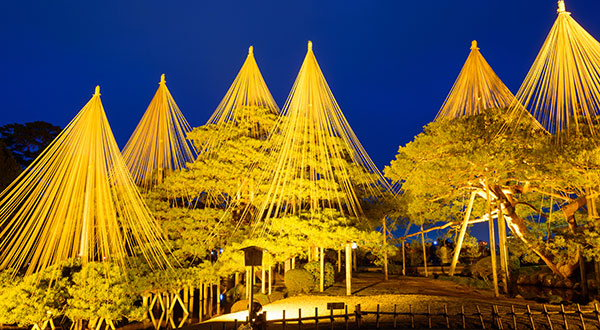
Winter (December–March) is snow season, and Kenroku-en’s famous yukitsuri — elaborate rope structures tied from the tips of pine tree branches to central poles to protect them from snow damage — are a distinctly Kanazawa aesthetic that appears on every winter travel image of the city. This is also peak crab season. The city’s museums provide excellent indoor programming regardless of weather.
Summer (July–August) is relatively cool by Japanese standards, making Kanazawa a practical summer escape from the heat of Tokyo and Osaka.
Wi-Fi, eSIM & Staying Connected in Kanazawa
Kanazawa’s central districts have reliable mobile coverage. The Higashi Chaya, Nagamachi, and Kenroku-en areas are well served by major carriers.
We recommend activating an eSIM service such as Ubigi before arriving in Japan. Kanazawa’s bus network (the main way to move between districts without walking) requires checking real-time schedules — a data connection significantly simplifies navigation. The Kanazawa Loop Bus (¥200 per ride / ¥600 day pass) connects all major sightseeing areas; route maps are available at the station.
Summary|Planning Your Kanazawa Trip
Kanazawa stands apart from Japan’s heavily trafficked Golden Route as a destination that delivers comparable cultural depth — preserved historical districts, world-class gardens, extraordinary seafood, and excellent contemporary art — at a fraction of the crowd levels. For visitors who have already experienced Tokyo, Kyoto, and Osaka, Kanazawa is the natural next step.
Allow a minimum of 2 nights to cover the main sightseeing areas without rushing. Visit Omicho Market on your first morning, spend an afternoon in Higashi Chaya and Nagamachi, dedicate the second day to Kenroku-en (early morning) and the 21st Century Museum (afternoon). A third night allows for a day trip to the Noto Peninsula.

コメント